

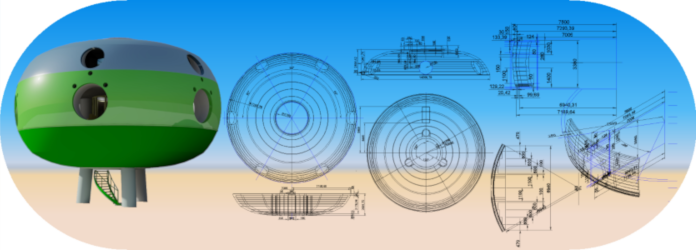
The Safe House
The forces of nature are incalculable. Also, the type of force changes depending on the location on the earth. In designing the safe house, I tried to create a design, of a house, that offers safety in most places on earth.
At ESA, even shown interest. Further developments would have to take place before it can be applied to Mars.
The reasons why the safe house was developed
Functionality of a shape
For centuries, architects and artists have known that curved lines are much more connected to nature than straight lines. A. Gaudi and Le Corbusier left enough works to illustrate this. They use round shapes and place buildings on columns and did this already 80 years ago.
The design of the safe house is a further development on some of the ideas of A. Gaudi and Le Corbusier. From the A. Gaudi to work with more round shapes and from Le Corbusier 4 of his 5 guidelines have been used. But more modern ideas have also been incorporated.
In the time after the 2nd World War, many buildings were erected where the number and low cost determined the main file of the architecture. The necessary of these have already disappeared in the Netherlands. From time to time architecturally interesting buildings have been erected. The Evoluon from 1966 in Eindhoven by Louis Kalff and Leo de Bever. This was not a cheap building but it has a high quality appearance of the technical possibilities of the time. The Kasbah from 1973 in Hengelo and from 1984 the cube houses in Rotterdam, both by Piet Blom. These were housing projects where experiments were conducted with other designs, within a tight budget. There will be more examples internationally. Below is a list of some contemporary buildings.
Since 1970, awareness of the environment and personal well-being has brought about a change in architecture. A spiritual development that requires more harmony with nature, preferably energy neutral and certainly not polluting the environment. This is where the “cradle to cradle” concept arose. The origin, production, recycling and environmental impact of all materials used must be registered for the entire period that they are used in the construction work. “Cradle to cradle” stands for from birth to death. So from construction to the moment the building is demolished. It must therefore be known where it comes from and what happens to the residual materials. Can it be reused or what is the further burden on the environment when destroyed?
Inspiration
The source of inspiration for this construction technique is the bus station in Hoofddorp. By making the parts from synthetic foam and providing them with a sufficiently load-bearing layer of glass fiber reinforced polyester on site, a plastic building has been created. I was told that if it had been built entirely in traditional concrete construction, the building would have cost more than 10 times the current budget. Some links of this building are also included.
The 12 segment division comes from the 12 stars on the EU flag.
Building
Living and working in a building is in itself a counter-natural act. Due to our evolution, we have become accustomed to staying in buildings. The question is whether most people can survive without shelter.
If we ensure that there is a good indoor climate in a building for people, it will be possible to live and work in it optimally. People's sense of happiness and productivity may increase and may become optimal. There are other factors that influence happiness.
What a building really does is shut out nature. It is a barrier that makes it possible to offer people a pleasant living environment. The better the barrier, the easier it is to adapt the indoor climate to our wishes.
That barrier must offer a high heat resistance and a moisture barrier. Depending on the situation, it is desirable to have a lot or little direct sunlight, especially infrared. In a warm climate there is no need for infrared. The opposite is in a cold climate. There is an extra need for infrared to heat the building in a natural way. An insulating foam layer with a layer of glass fiber reinforced polyester over it forms an excellent barrier that, depending on the thickness of the layers, offers the sufficient insulation and waterproof layer. The energy consumption of the building and maintenance costs can thus be positively influenced. A round shape allows water to drain evenly. When this water is collected, it can be used as a greywater circuit. By not making the windows too big and by placing them deep in the facade, less direct sunlight comes in, which results in less heating. In a well-insulated building, the electrical appliances, lighting and people are the heat sources. LED lighting can be used where there is no daylight. The LED lighting uses less energy and produces less heat. Less heat also means that less energy is needed for cooling. By using the floors as a cooling surface, a more even temperature is created in the rooms and the incoming air only needs to be brought up to temperature. Consequences, no cold wind in your neck and much less noise pollution. At the recesses of the windows are grilles through which the air can be refreshed. It is precisely because of the construction of the building that a natural air flow can arise. The building stands on legs off the ground. The central interior space is covered with a skylight, on an edge with ventilation grilles. The air vents allow the warm air trapped under the dome to escape. The heat is generated there by the sunlight and by the cooling panels that are placed just below the ventilation / wind turbine edge. If the warm air escapes through the grilles in the rim under the dome, air will be drawn in from below. This flow of air comes from under the building but also through ventilation grids in the glass wall around the central space. This means that the spaces within the building are ventilated with as little mechanical assistance as possible.
Solar panels are placed around the skylight on the almost flat part of the ring. These will provide part of the energy requirement. Rainwater collection points are located under the solar panels. Part of this rainwater will be stored in tanks in the building and will be used for flushing the toilet, the so-called greywater circuit. It is possible that part of the greywater will be stored in plastic or concrete reservoirs in the ground. Part of the heat panels in the central interior spaces could also be converted into drinking water through evaporation and condensation. The operation is comparable to the "heatpipe system". With a “heatpipe system” heat can be extracted from the air up to 4 °C.
Access
The entrance to the building is in the central interior space. A twisted staircase connects to the floors. In the center of the building there will be a hydrological largely transparent elevator cabin that can rotate around the vertical axis and open onto the landings of the stairs at the various floors. In this way, heavier loads can also be transported up to the maximum capacity of the lift.
Because the building is on legs, there is shade under the building. In the dry period it will also be pleasant to stay there.
Security
A sprinkler system with fog nozzles will be installed against fire. This type is used on luxury passenger ships. Breathing is possible in this fog, it prevents the fire from spreading and does not immediately make the environment soaking wet.
If the ventilation openings near the round windows are placed with fans that can blow in two directions, it is not possible to only be ventilated in a forced way, but also the smoke in the event of a fire is extracted.
If desired, special doors can be placed in the facade, which are provided with inflatable slides at the bottom. Like with airplanes.
By choosing the right place for the water tanks within the building and hanging them up, they can be used as dampers during earthquakes.
Cost
The choice of a concrete foundation, stainless steel legs, plastic frames and wooden cladding inside and an outer wall of plastic foam with glass fiber reinforced polyester certainly has a positive effect on the construction costs. The inner walls are made of plastic foam and plasterboard on both sides. The moisture-regulating effect increases the quality of the indoor climate.
Personal
Although I am an aerospace and SF enthusiast, it was never my intention to build a UFO-like building.
My goal is to set a clear boundary from where our environmental control ends and Mother Nature begins her empire. Hence the chosen shape that has already been called a womb, egg or “cocoon” and also UFO. Partly for this reason, the whole is set up to emphasize the independence of Mother Nature. The area beyond should only be influenced by us in harmony with Mother Nature.
Example list of websites with modern buildings
http://www.akar.nl/referenties/almere/fashion-centre-
http://www.earthview.nl/bol_woningen_in_den_bosch_vlijmen-t5416.0.html
http://www.laroes.nl/projecten.html
http://nl.wikipedia.org/wiki/Postmodernisme_%28architectuur%29
http://www.pixelen.nl/vk_blog/2008/02/18/organische-architectuur-antti-lovag/
http://www.eindhoveninbeeld.com/overzicht.php?groep2=13&subcat2=111
http://www.flickr.com/photos/24571671@N08/5838323251
http://www.haac.nu/?p=25
http://www.dbnl.org/tekst/sten009monu02_01/sten009monu02_01_0030.php
http://www.joostdevree.nl/shtmls/dakvormen.shtml
http://www.flickr.com/photos/alje/4401073246/
http://www.flickr.com/photos/8293801@N07/page11/>
http://www.huffingtonpost.com/2012/06/12/al-dar-headquarters--mz-a_n_1589678.html?utm_hp_ref=architecture
http://www.waymarking.com/waymarks/WMBRR9_Kugelmugel_in_Vienna_Austria
http://www.extravaganzi.com/the-best-office-building-in-the-world-apple%E2%80%99s-new-hi-tech-headquarters/
http://www.stadsverkenner.com/londen/cityhall
http://www.nowthatsnifty.com/2009_08_23_archive.html#.UJQTiIanX9Y
http://ethel-baraona.tumblr.com/post/344119340/geisel-library-the-distinctive-original-building
http://armchairtravelogue.blogspot.nl/2009/10/unique-saturn-shaped-building-lucknow.html
http://www.homesresult.com/2010/08/unique-house-tree-shaped-ball/
http://secure.scudamores.com/blog/?p=102
http://www.topsider.com/beachfront-homes.asp
http://newyorkphotoblog.blogspot.nl/2007/05/washington-heights-fairview-avenue_05.html
http://dianepernet.typepad.com/diane/2010/01/fashion-rio-fallwinter-2010-part-3-text-most-photos-by-glenn-belverio.html
http://www.treehugger.com/sustainable-product-design/when-carbon-neutral-buildings-dont-add-up.html
http://www.galinsky.com/buildings/ing/
http://www.galinsky.com/buildings/hoofddorpbus/
http://www.flickr.com/photos/klaasfotocollectie/3044180060/
http://www.free-d.nl/project/show/id/133